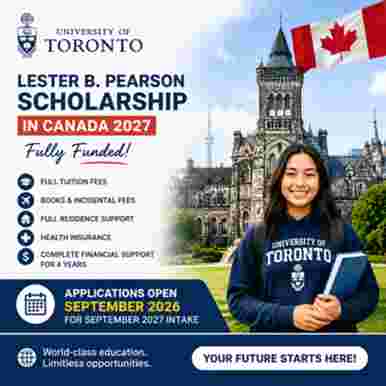
Securing graduate funding is arguably the most critical milestone in a doctoral student’s academic journey. Not only does it provide the financial freedom necessary to focus entirely on your research, but it also serves as a prestigious mark of excellence that will follow you throughout your career. Among the most coveted awards in North America is the Canada Graduate Scholarship – Doctoral (CGS D) program.
With the recent enhancements to federal research funding, the CGS D is now more lucrative than ever, offering $40,000 per year for up to 36 months (three years). For the 2027 academic cycle (which begins accepting applications in the fall of 2026), competition will be incredibly fierce.
Whether you are just beginning to draft your research proposal or you are trying to understand the labyrinth of Tri-Agency deadlines, this comprehensive, 2,000+ word pillar guide will walk you through the entire process step-by-step. Furthermore, we will compare this Canadian powerhouse to alternative international funding options to help you strategize your academic future effectively.
Part 1: What is the Canada Graduate Scholarship – Doctoral (CGS D)?
The Canada Graduate Scholarships—Doctoral (CGS D) program is a federal initiative designed to promote continued excellence in Canadian research by rewarding and retaining high-calibre doctoral students at Canadian institutions.
The scholarship is administered jointly by Canada’s three major federal granting agencies, collectively known as the Tri-Agencies:
-
CIHR (Canadian Institutes of Health Research): Funds research in health, medicine, psychology, and clinical sciences.
-
NSERC (Natural Sciences and Engineering Research Council): Funds discovery research in engineering, fundamental sciences, computing, and mathematics.
-
SSHRC (Social Sciences and Humanities Research Council): Funds research in the arts, humanities, business, economics, and social sciences.
Value and Duration
Historically valued at $35,000, recent federal budget updates have elevated the CGS D to $40,000 per year. The award is tenable for up to 36 months. This $120,000 total package is designed to cover living expenses, research costs, and tuition, allowing you to treat your PhD as a full-time profession.
Part 2: Eligibility Requirements for the 2027 Cycle
Before you invest dozens of hours into an application, you must verify your eligibility. The Tri-Agencies are notoriously strict regarding these rules. To apply for the 2027 CGS D cycle, you must meet the following criteria:
1. Citizenship and Residency
You must be a Canadian citizen, a permanent resident of Canada, or a Protected Person under subsection 95(2) of the Immigration and Refugee Protection Act (Canada) as of the application deadline.
2. Academic Standing
While specific GPA requirements can vary slightly depending on your institution’s internal vetting process, you generally need a first-class average (typically an A- or 80% minimum) in each of the last two years of full-time study.
3. Program Enrollment and Study Limits
-
You must be enrolled in, or intend to apply for full-time admission to, an eligible doctoral program.
-
As of December 31, 2026 (for the 2027 award cycle), you must have completed no more than 36 months of full-time study in your doctoral program.
-
If you are in a joint program (like an MD/PhD or MA/PhD), specific calculation rules apply to your months of study.
4. Tenability (Where You Can Study)
The CGS D is generally tenable only at eligible Canadian universities. However, there is an exception: If you have already completed at least one degree (undergraduate or graduate) at a Canadian university, you may be eligible to take your CGS D funding to a foreign institution, provided you meet all other criteria.
Part 3: Step-by-Step Application Guide for CGS-D 2027
The application process for the 2027 cycle will begin in the late summer of 2026, with major deadlines hitting in September and October. Follow these steps meticulously.
Step 1: Identify Your Agency and Application Channel
Your very first task is to determine which of the three agencies (CIHR, NSERC, or SSHRC) aligns with your research. Applying to the wrong agency will result in immediate disqualification. If your research bridges disciplines (e.g., health policy or biomedical engineering), consult the Tri-Agency guidelines on “Selecting the Appropriate Federal Granting Agency” to ensure your proposal is evaluated by the correct experts.
Next, determine your application channel:
-
Through a Canadian Institution: If you are currently registered at a Canadian university with a CGS D quota, you must apply through your university. Your internal deadline will likely be in September or early October 2026.
-
Directly to the Agency: If you are not currently enrolled, or if your university does not have a quota, you will apply directly to the agency by their standard deadline (typically mid-October 2026, around October 17th).
Step 2: Draft a Winning Research Proposal
Your research proposal is the heart of your application. You are allowed a strict maximum of two pages for the proposal itself, plus a bibliography/citation page.
To maximize your score, structure your proposal with clear headings:
-
Background/Context: What is the current state of the literature, and what gap are you filling?
-
Research Objectives/Questions: What exactly are you trying to find out? Be specific.
-
Methodology: How will you conduct this research? Outline your data collection, analytical frameworks, or experimental designs. Do not gloss over this; reviewers want to see that your project is feasible.
-
Significance/Impact: Why does this research matter to Canada and the world?
Insider Tip: Your application will be reviewed by a multidisciplinary committee. An English professor might review a History proposal; a Biologist might review a Physics proposal. Eliminate hyper-specific jargon and ensure an educated layperson can understand your objectives and methodology.
Step 3: Secure Outstanding Letters of Appraisal
You will need two letters of reference. Do not choose professors simply because they are famous in their field; choose referees who can speak specifically and enthusiastically about your research potential and academic history.
How to manage your referees:
-
Ask them early (by August 2026).
-
Provide them with a “Referee Package” containing your draft research proposal, your updated CV, and a bulleted list of your key achievements.
-
Remind them of the deadline. The portals will not allow you to submit your application until both referees have uploaded their letters.
Step 4: Perfect Your Academic CV
Depending on the agency, you will either use the Canadian Common CV (CCV) (for CIHR) or the agency’s specific Web CV (for SSHRC and NSERC).
The CV is where you prove you have the pedigree to execute your proposal. Highlight:
-
Refereed publications (journals, book chapters).
-
Conference presentations (oral and poster).
-
Previous academic awards and scholarships.
-
Relevant professional, volunteer, or leadership experience.
Step 5: Order Official Transcripts
You must provide up-to-date transcripts for all post-secondary studies. If you are beginning a new program in Fall 2026, you must include a transcript for that term, even if it just shows you are registered and no grades have been assigned yet. Ensure you include the transcript legend/key provided by the registrar’s office.
Step 6: Final Verification and Submission
Tri-Agency portals (ResearchNET for CIHR, the NSERC Online System, and the SSHRC Online System) are notoriously clunky. You must click “Verify” on every single page module. Do not leave submission to the last hour; the servers frequently crash on deadline day due to high traffic.
Part 4: How the Committee Evaluates Your Application
Understanding the scoring rubric is the secret to a successful application. The CGS D is evaluated on a strict 50/50 split between two core criteria.
50% — Research Ability and Potential
The committee will look at the quality of your research proposal. Is it original? Is the methodology sound? They will also look at your research history. Have you published papers? Have you presented at conferences? Have you demonstrated that you can see a project through from conception to completion?
50% — Relevant Experience and Achievements Obtained Within and Beyond Academia
This section evaluates your academic record (your transcripts and previous awards). However, it also deeply values leadership and professional experience. Have you mentored junior students? Have you managed a lab, led a community initiative, or worked in a field related to your research? The Tri-Agencies have modernized their criteria to recognize that non-traditional academic paths and community engagement are highly valuable indicators of future success.
Part 5: Expanding Your Horizons: Comparing Canadian Funding to International Options
While the CGS-D is one of the most lucrative Canadian options, many prospective academics weigh this against studying south of the border. Entering graduate school is a massive commitment, and securing the right grants for research can dictate the trajectory of your entire career.
If you are comparing a Canadian doctorate to phd fully funded scholarships in usa, you will find that US stipends often include comprehensive tuition waivers, whereas the CGS-D provides a flat rate from which you must pay your own tuition. Furthermore, international scholars often search for phd scholarships in usa for international students because the Canadian CGS-D is strictly restricted to Canadian citizens and permanent residents.
For those earlier in their academic journey who intend to apply for masters before committing to a doctoral path, exploring a masters program in usa with scholarship is highly recommended. Many top-tier universities offer excellent masters program scholarships usa. Students looking to apply for masters scholarship opportunities will find that securing a fully funded masters degree or master degree fully funded scholarships provides a crucial stepping stone. The landscape for masters scholarships in usa is vast. If you need a master degree scholarship in usa, it is vital to search specifically for masters scholarships fully funded to avoid heavy student debt. Securing a masters scholarship for international students in usa requires early outreach to faculty. Similarly, a usa masters scholarship for international students or us masters scholarships for international students can cover both living stipends and tuition costs. International students looking for a scholarship for masters in usa for international students or a master degree full scholarship for international students should utilize comprehensive university databases and departmental financial aid pages.
But what about the foundations? Many of today’s top doctoral candidates began their journey by looking for an undergraduate scholarship in usa. Finding scholarships for undergraduate students in usa or a fully funded scholarship in usa for undergraduate degrees gives international students the research pedigree and faculty connections needed for later graduate success. From general undergraduate scholarships in usa for international students to specific STEM funding, securing an early scholarship usa can permanently change a student’s academic trajectory.
Whether you are looking for general international students scholarships in usa or specifically seeking a postgraduate scholarship in usa, early preparation is the key to success. There are ample scholarships for postgraduate students—as well as specialized scholarships for post graduate students—available for those willing to do the legwork. Many bright minds aspire to study in usa with scholarship support, often landing a prestigious usa university scholarship or a localized, institution-specific university of usa scholarship. Broadening your search ensures that if the Canadian CGS-D does not pan out, your academic dreams remain fully funded.
Part 6: Insider Tips for a Winning 2027 Application
To push your CGS D application from “good” to “funded,” keep these advanced strategies in mind:
1. Master the Formatting Rules
The Tri-Agencies will reject your application for incorrect margins or fonts. If they mandate Times New Roman 12pt with 3/4-inch margins, adhere to it strictly. Do not try to shrink the font to squeeze in an extra paragraph. Reviewers appreciate white space and readability.
2. Address Equity, Diversity, and Inclusion (EDI)
Modern research grants place a heavy emphasis on EDI. When outlining your methodology, consider how your research impacts diverse populations. Does your experimental design account for sex and gender variables? Is your participant pool diverse? Acknowledge these factors in your proposal.
3. Respect Indigenous Research Protocols
If your research involves Indigenous communities, lands, or knowledge, your proposal must explicitly demonstrate adherence to the TCPS 2 (Chapter 9) guidelines on research involving the First Nations, Inuit, and Métis Peoples of Canada. You must emphasize reciprocity, cultural safety, and community engagement. Failure to do so will result in poor scoring on the feasibility and ethics portions of the evaluation.
4. Seek Aggressive Peer Review
Do not submit a first draft. Finish your proposal by late August 2026 and give it to your supervisor, a peer in your discipline, and a peer outside of your discipline. If the person outside your discipline cannot understand your core objectives, your proposal is too dense and needs to be simplified.
5. Start the CCV Early
If you are applying to CIHR, the Canadian Common CV is notoriously frustrating to navigate. It can take a full week just to input all your publications, dates, and funding history into their rigid drop-down menus. Create your account and begin populating this data months in advance.
Conclusion: Preparing for the 2027 CGS D Cycle
Winning a Canada Graduate Scholarship – Doctoral award is a transformative achievement that pays dividends far beyond the $120,000 monetary value. It opens doors to postdoctoral fellowships, signals your viability as an independent researcher to future hiring committees, and connects you to a network of elite scholars.
As you prepare for the 2027 cycle, remember that success relies on early preparation, meticulous attention to detail, and the ability to communicate complex ideas with absolute clarity. Begin drafting your proposal early, communicate with your referees well in advance of the October 2026 deadlines, and take the time to refine every single sentence in your application. With dedication and a strategic approach, you can secure the funding necessary to make a lasting impact in your field.